
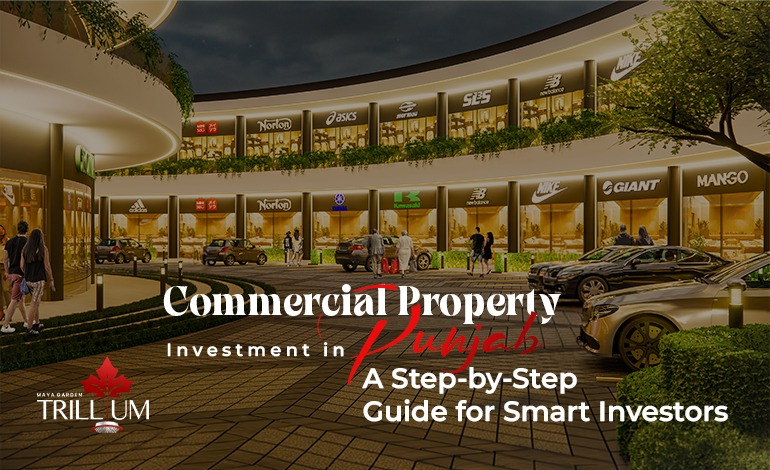
Commercial property investment in Punjab means buying retail shops, showrooms, offices, or mixed-use units to earn rental income, hold for appreciation, or run your own business. Success depends on location, tenant demand, the full cost of ownership and legal due diligence, not on size or price alone.
A promising location or an attractive concept does not automatically deliver rent or capital growth. This guide shows how to assess opportunities in Punjab, calculate returns, understand risks and evaluate a live example: Maya Garden Trillium, a Canada-inspired high street retail and lifestyle project on the Patiala-Sangrur National Highway (NH-7), developed by Maya Garden Group.
Why Consider Commercial Property Investment in Punjab?
Punjab’s economy spans retail, manufacturing, agri-based business, logistics, hospitality and professional services. Each sector needs different premises, which creates opportunities across shops, showrooms, food outlets, offices and warehouses, provided you assess each market individually.
Not every city, highway or development performs equally well. Look at three factors:
- Rental income: Depends on purchase price, tenant demand, lease terms, occupancy and operating costs. Compare achievable rents for similar properties with your total cost of ownership.
- Long-term appreciation: Values may rise as business activity grows or infrastructure improves, but this is uncertain. Consider competing supply and changing market conditions.
- Format variety: Showrooms, cafés, restaurants, warehouses and mixed-use developments all exist. Choose a property that meets a genuine business need, not one that simply follows a popular trend.
How Do You Invest in Commercial Real Estate in Punjab?
Invest in five steps: set your budget and objective, pick a property category, evaluate location and accessibility, model your returns, and complete legal due diligence. A structured process lets you compare options and catch problems before committing capital.
Step 1: Define your budget and objective
Decide whether you want rental income, a space for your own business, long-term appreciation or portfolio diversification. Budget for more than the purchase price:
- Taxes and transaction charges
- Legal and professional fees
- Financing costs
- Maintenance expenses
- A reserve for unexpected costs
If you are borrowing, check whether you could still meet repayments during a vacancy.
Step 2: Choose a property category
| Category | Best suited to | Key considerations |
| Retail shops and showrooms | Fashion, consumer goods, electronics | Frontage, footfall, display space |
| High street retail | Clusters of complementary businesses | Visibility, access, tenant mix |
| Food and beverage | Restaurants, cafés, takeaway | Utilities, ventilation, service access, permissions |
| Offices | Professional services | Local employment and business demand |
| Industrial and warehouse | Logistics, storage | Road access, loading, specifications |
Weigh potential income against the complexity of leasing and managing each type.
Step 3: Evaluate location, visibility and accessibility
Check these points for any retail-oriented property:
- Road connectivity and ease of reaching the site
- Visibility from surrounding roads and permitted signage
- Entry and exit arrangements, parking and internal circulation
- Nearby residential areas, businesses and customer groups
- Existing retail competition and upcoming commercial supply
- Utilities and supporting infrastructure
Why Is High Street Retail Worth Evaluating?
High street retail brings shopping, dining and lifestyle businesses together in a setting built around visibility, access and customer experience. It can suit investors when the tenant mix, location and unit design match real consumer demand.
- Visibility and convenience: Visible units help businesses reach passing customers, and convenient parking and clear circulation improve the visit. Visibility alone does not guarantee sales or reliable rent.
- Complementary mix: Shopping, dining, cafés and entertainment can draw different customer groups and encourage visits for more than one purpose, if the local catchment supports the mix.
- Unit suitability: Frontage, floor area, ceiling height, loading arrangements, signage, utilities and permitted use all decide which businesses can operate in a unit.
What Is Maya Garden Trillium?
Maya Garden Trillium is a newly launched, premium commercial development by Maya Garden Group on the Patiala-Sangrur National Highway (NH-7). It spans five acres with about 400 feet of highway frontage and combines showrooms, factory outlets, dining formats, cafés and entertainment under a Canada-inspired high street concept.
Project snapshot
| Feature | Detail (per project brief) |
| Developer | Maya Garden Group |
| Location | Patiala-Sangrur National Highway (NH-7) |
| Site area | Five acres |
| Highway frontage | Approx. 400 feet |
| Concept | Canada-inspired high street retail and lifestyle |
| Entertainment | 24,000 sq. ft. gaming and entertainment zone |
| Planned formats | Premium showrooms, factory outlets, drive-through food formats, cafés, food court, craft microbrewery spaces |
Five features investors should examine
- Highway location and frontage. About 400 feet of frontage on NH-7 supports visibility and brand exposure for customer-facing tenants. Review access arrangements and site plans to see how signage, entry and traffic movement work in practice.
- Five-acre scale. A larger site allows planned zoning: unit placement, pedestrian circulation, parking and common facilities. Ask for plans and specifications before evaluating any individual unit.
- Canada-inspired identity. The name refers to the trillium, Ontario’s provincial flower, and the design draws on Canadian retail and lifestyle culture. A distinct identity helps a destination stand out, but tenant suitability, local demand and execution quality matter just as much.
- Gaming and entertainment zone. The 24,000 sq. ft. zone, with spaces up to 33 feet high, is designed to give visitors another reason to come, which may complement retail and food tenants. Confirm final specifications, approved uses and delivery status with the developer.
- Mixed formats. A showroom needs frontage and display space; a café needs utilities, ventilation and seating. Assess each unit according to its intended use rather than assuming all formats offer the same leasing potential.
How Do You Calculate Returns on Commercial Property?
Calculate returns by working out net operating income (NOI), which is effective rental income minus operating expenses, then dividing NOI by the purchase price to get the cap rate. Add financing, taxes, and capital expenditure for a complete picture.
Net operating income and cap rate
NOI = Effective rental income − Operating expenses Cap rate = NOI ÷ Purchase price × 100
Hypothetical example (not a projection for Maya Garden Trillium or any property): A unit costs ₹1 crore and earns ₹10 lakh a year in effective rent. Operating expenses are ₹2 lakh. NOI is ₹8 lakh, so the cap rate is ₹8 lakh ÷ ₹1 crore × 100 = 8%.
The cap rate is useful for comparing similar assets, but it ignores taxes, financing, future capital spending, and the eventual sale price.
Full cost of ownership checklist
- Purchase price and transaction charges
- Financing costs and interest
- Maintenance and common-area charges
- Insurance and property taxes
- Vacancy and rent-collection assumptions
- Fit-out, repairs and capital expenditure
- Legal, management and eventual sale costs
What Checks Are Needed Before Buying Commercial Property in Punjab?
Before buying, verify title and approvals, check RERA registration where applicable on the Punjab RERA portal, confirm the unit’s permitted use and rights, review payment and handover terms, and independently test leasing demand. Always take advice from a qualified local lawyer.
- Approvals and ownership. Review title, land-use permissions, sanctioned plans and building approvals. Check RERA status through the Punjab Real Estate Regulatory Authority where applicable.
- Commercial rights. Confirm exact unit area, ownership structure, permitted business use, access rights, parking, signage and common-area responsibilities. A “commercial” label does not mean every activity is allowed.
- Payment and handover terms. For a newly launched project, examine the payment schedule, completion obligations, specifications, approvals and remedies for delay. Get promised features confirmed in writing.
- Leasing demand. Review comparable properties and actual rental evidence, and speak with local market professionals. Treat projected footfall, illustrative rents and verbal assurances as non-guaranteed.
What Are the Risks of Commercial Property Investment?
The main risks are vacancy, tenant default, market change, construction and delivery delays, financing pressure, low liquidity and regulatory change. Hold adequate reserves and avoid justifying a purchase with optimistic rent assumptions.
| Risk | What it means |
| Vacancy | The unit stays empty longer than expected |
| Tenant | Default, early exit or non-renewal |
| Market | New supply, economic shifts or changing preferences weaken demand |
| Construction and delivery | Delays or changes to specifications and approvals in new projects |
| Financing | Interest-rate changes or refinancing difficulty |
| Liquidity | Selling can take time, and a quick sale may mean a lower price |
| Regulatory | Rule changes affecting permitted use and operating costs |
Explore Commercial Property Investment at Maya Garden Trillium
Commercial real estate investment in Punjab rewards careful assessment of location, business demand, specifications, financing, and legal compliance. Maya Garden Trillium offers a Canada-inspired high street retail and lifestyle concept on the Patiala-Sangrur National Highway, with five acres, about 400 feet of frontage and a planned mix of retail, dining and entertainment worth investigating.