
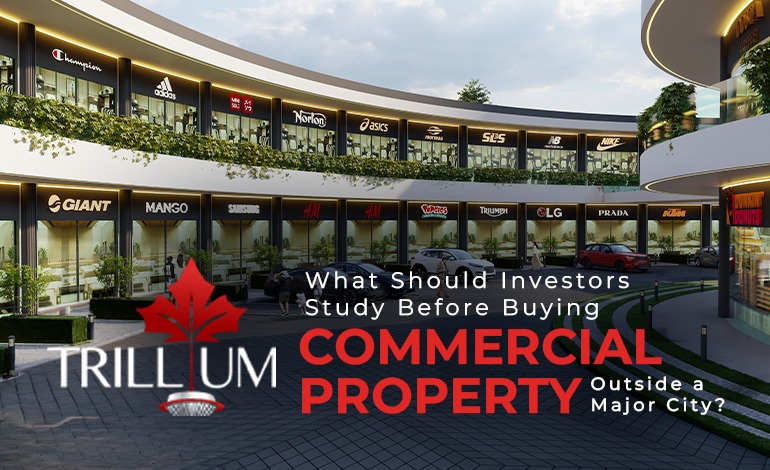
Buying commercial property outside a major city can open the door to attractive investment opportunities, particularly in secondary and tertiary markets where acquisition costs may be lower and initial cap rates can be higher. At the same time, these locations can come with different risks, including a smaller tenant pool, slower leasing activity, limited buyer demand, and greater exposure to local economic changes.
That makes research especially important before committing capital. A property that appears affordable today may face challenges later if employment declines, infrastructure changes, tenants leave, or finding a buyer becomes difficult. Investors should therefore look beyond the purchase price and study the economic, physical, operational, regulatory, and financial factors that can influence long-term performance.
Why Commercial Property Outside a Major City Requires Careful Research
Secondary and tertiary markets can benefit from population growth, new businesses, infrastructure investment, and expanding regional economies. These factors may create opportunities for investors who identify areas before they become more established commercial destinations.
However, smaller markets do not always have the economic depth of major metropolitan areas. A single employer leaving the region or a major development changing traffic patterns can have a much greater effect on local commercial demand.
Before buying, investors should answer a simple question: What will continue supporting this property’s value if current market conditions change? The answer should come from measurable fundamentals rather than assumptions about future growth.
1. Study Macroeconomic Drivers and Employer Concentration
The strength of the surrounding economy is one of the first things investors should examine. Commercial properties depend on businesses, employees, customers, and local spending, so understanding what drives the area’s economy can provide valuable insight into future demand.
Major metropolitan markets usually have a broad mix of industries and employers. Smaller markets can be more concentrated, which means the closure of one factory, reduction in university funding, or departure of a major company could affect employment and commercial activity across the area.
Identify the Major Local Employers
Start by identifying the top three to five employers in the county or municipality. Study their industries, workforce size, expansion plans, financial stability, and history in the region.
A market supported by several established employers may have a different risk profile from one that relies heavily on a single company. Investors should also investigate whether new employers are entering the area, because future job creation can influence demand for retail, office, industrial, and service-oriented properties.
Examine Job and Population Growth
Population growth can support commercial real estate demand, but one strong year does not necessarily establish a long-term trend. Investors should examine employment and population data over a five-to-ten-year period to identify whether growth has been consistent.
Look at both the quantity and quality of growth. New jobs in diverse industries, rising household formation, business expansion, and sustained population increases can provide stronger support for commercial demand than a temporary population spike.
Assess Economic Diversification
Economic diversification deserves particular attention when evaluating commercial property outside a major city. Markets heavily dependent on manufacturing, energy, tourism, agriculture, or another single industry can be more vulnerable when that sector experiences a downturn.
This does not automatically make single-industry markets unsuitable for investment. Instead, investors should understand the additional concentration risk and determine whether the property’s lease term, tenant quality, pricing, and other fundamentals adequately account for it.
2. Evaluate Infrastructure and Transit Connectivity
Location remains fundamental to commercial real estate, but accessibility is about more than the property’s address. Businesses need customers to reach them, employees need reliable transportation, and logistics-oriented tenants need efficient routes for moving goods.
When studying commercial real estate outside major cities, investors should examine both existing infrastructure and planned improvements. Changes to roads, transportation routes, and utilities can influence the property’s future accessibility and operating potential.
Examine Highways and Logistics Routes
Determine how close the property is to major highways, arterial roads, freight corridors, airports, ports, or other important transportation infrastructure. The importance of each connection depends on the property’s intended use.
For example, a warehouse may benefit significantly from proximity to freight routes, while a retail property may depend more heavily on visibility, traffic volume, parking, and convenient customer access.
Review Planned Infrastructure Projects
Current road conditions are only part of the analysis. Investors should also review local Department of Transportation plans and municipal development proposals.
Road widenings, bypasses, new interchanges, route changes, and major transportation projects can affect commercial properties in different ways. Improved access may increase convenience, while a new bypass could potentially divert traffic away from an existing retail or service location.
Check Utility Capacity
Utilities are another factor that can influence a property’s usability and future value. Verify that water, sewer, electricity, natural gas, and high-speed internet are available and have sufficient capacity for the property’s current and potential commercial uses.
This becomes particularly important when an investor intends to renovate, expand, change the property’s use, or attract a different type of tenant. Infrastructure limitations discovered after purchase can lead to unexpected costs and delays.
3. Understand Local Leasing Dynamics and Tenant Replacement
A low vacancy rate does not necessarily mean that a small commercial market has strong leasing liquidity. In areas with limited transaction volume, headline vacancy figures can provide an incomplete picture of how quickly landlords can actually find replacement tenants.
For investors considering commercial property outside a major city, the more useful question is often: How long would this property remain vacant if the current tenant left?
Calculate Potential Re-Leasing Time
Research comparable properties and determine how long they typically remain vacant between tenants. In some major urban markets, certain properties may find replacement tenants within several months, whereas regional markets can experience substantially longer periods of downtime.
Longer vacancy periods can affect cash flow because property taxes, insurance, maintenance, financing costs, and other expenses may continue even when rental income stops. Investors should therefore include realistic downtime assumptions in their financial models rather than assuming immediate occupancy.
Evaluate Tenant Credit Quality
The tenant can be just as important as the building itself. Review the existing lease agreements, tenant financial strength, lease duration, renewal options, rent escalation provisions, and security arrangements.
Pay attention to whether a tenant is backed by a corporate guarantee or operates through a franchise structure with different levels of financial support. Lease expiration schedules should also be examined because several major leases expiring around the same time can create concentrated income risk.
Study Submarket Absorption and New Supply
Future competition can change the economics of a property. Investors should identify commercial projects that are already under construction, approved, proposed, or actively being marketed in the surrounding submarket.
A significant amount of new retail, office, industrial, or mixed-use space could increase tenant choices and affect rents. Understanding local absorption and the development pipeline helps investors assess whether current leasing conditions are likely to remain sustainable.
4. Examine Zoning, Regulations and Property Tax Dynamics
Local government policies can directly affect how a commercial property is operated and developed. Regulations may also influence operating costs, renovation plans, signage, parking, and future changes to the property.
Before purchasing, investors should understand not only what the property is being used for today, but also what uses may be permitted in the future.
Verify Zoning and Permitted Uses
Review the property’s zoning classification and permitted uses. Investors should also check parking requirements, signage restrictions, building regulations, setback requirements, and relevant permitting procedures.
If the investment strategy depends on changing the property’s use, confirm how difficult it would be to obtain the required approvals or variances. A property with a low purchase price may become less attractive if regulatory restrictions significantly limit its potential uses.
Investigate Property Tax Trends
Property taxes can directly influence net operating income and investment returns. Historical tax records can provide insight into how assessments have changed over time.
Investors should also understand whether the local authority reassesses commercial properties following a transaction. A substantial increase in assessed value could result in higher property taxes after acquisition, changing the property’s projected cash flow.
Conduct Environmental Due Diligence
Environmental risks should not be overlooked, particularly when purchasing older commercial or industrial properties. A Phase I Environmental Site Assessment (ESA) can help identify potential concerns related to historical land use and potential contamination.
Flood exposure, previous industrial activity, underground storage tanks, soil contamination, and other environmental issues can create significant financial and legal considerations. Identifying potential problems before closing allows investors to investigate them properly and account for any required remediation.
5. Assess Exit Liquidity and Capital Markets Access
Buying a property is only one part of a commercial real estate investment strategy. Investors also need to consider what happens when they eventually refinance or sell the asset.
Exit liquidity can be more limited in smaller markets because there may be fewer active investors, lenders, and institutional buyers. Consequently, understanding the potential exit market should happen before acquisition rather than after the investment has been made.
Understand Local Lender Appetite
Talk to regional banks, credit unions, and other lenders that actively finance the relevant property type. Their willingness to fund similar transactions can provide useful insight into local capital market conditions.
Investors should examine loan-to-value requirements, interest rates, debt service expectations, refinancing options, and lender preferences for specific asset classes. Financing conditions can influence both the initial acquisition and the property’s future sale or refinancing prospects.
Identify the Potential Buyer Pool
Think about who could realistically purchase the property in the future. Depending on the asset and market, potential buyers could include local investors, regional syndicators, family offices, owner-occupiers, or larger investment groups.
A clear understanding of the potential buyer pool can help investors assess exit timelines and pricing assumptions. If only a small number of buyers are likely to be interested, the property may require more time to sell than a comparable asset in a major metropolitan market.
A Practical Due Diligence Checklist
Before buying commercial property outside a major city, investors can organize their research around five questions:
- Economy: Is the local economy growing, and is employment supported by multiple industries?
- Location: Does the property have strong transportation access and adequate utilities?
- Leasing: How deep is the tenant pool, and how long could it take to replace a tenant?
- Regulation: Are zoning, taxes, environmental conditions, and permitting requirements understood?
- Exit: Are lenders and potential buyers active enough to support refinancing or a future sale?
Answering these questions does not eliminate investment risk, but it can make the decision-making process more informed. More importantly, it helps investors distinguish between a property that simply looks inexpensive and one that has fundamentals capable of supporting its long-term value.
Final Thoughts
Commercial property outside a major city can provide opportunities through lower acquisition costs, potentially higher initial cap rates, and exposure to growing regional economies. Yet these advantages need to be considered alongside the challenges of smaller tenant pools, longer vacancy periods, local economic concentration, and potentially limited exit liquidity.
The strongest due diligence goes beyond studying the building itself. Investors should examine the economy surrounding the property, infrastructure connecting it to customers and businesses, local leasing conditions, zoning and tax requirements, environmental considerations, financing availability, and the potential buyer pool.
Ultimately, the goal is to understand how the property could perform under different market conditions. A detailed assessment of both the opportunity and the risks can help investors build a more realistic financial model and make a better-informed commercial real estate investment decision.