
When evaluating commercial real estate, size is often one of the first factors investors and business owners consider. A larger shop, a larger floor plate, or an expansive commercial space may appear to offer greater value at first glance. However, square footage alone does not determine how effectively a property can support a business or attract customers.
A smaller commercial space with strong road visibility, convenient access, and consistent footfall can sometimes offer greater business potential than a much larger unit tucked away from the main movement. In commercial property, being seen can be just as important as having space.
Why Bigger Does Not Always Mean Better in Commercial Real Estate
Several factors beyond physical size influence the value of commercial real estate. Location, accessibility, surrounding development, customer movement, frontage, connectivity, and the quality of the commercial ecosystem can all influence how a property performs.
Consider two shops with similar specifications. One is positioned directly along a busy road with clear signage and convenient access, while the other is located deeper inside a development with limited visibility. The second property may offer more space, but the first could provide a stronger platform for customer-facing businesses.
For retailers, restaurants, cafés, salons, and other businesses that depend on walk-ins, visibility can influence customer discovery. A property that naturally catches attention can give a business an advantage before a customer even decides to enter.
What Makes a Commercial Property Truly Visible?
Visibility is more than simply being located beside a road. It is a combination of how easily a property can be noticed, accessed, and remembered by people moving through the area.
Frontage and Road Presence
A property with prominent frontage can provide businesses with greater opportunities to display their brand. Wider frontage can accommodate clearer signage, larger storefronts, and stronger visual communication.
Corner units and road-facing shops can also benefit from exposure from multiple directions. For businesses operating in a competitive commercial environment, these differences can influence how easily customers identify a store.
Footfall and Customer Movement
Visibility becomes more meaningful when it is supported by relevant customer movement. A property may have an impressive road presence, but its commercial potential also depends on who passes through the location and why.
High pedestrian movement, nearby residential communities, offices, entertainment destinations, and complementary businesses can contribute to a stronger commercial ecosystem. This is particularly relevant when considering commercial shop investment in Punjab, where location and surrounding development can influence business activity.
Signage and Brand Visibility
A storefront is often the first interaction between a customer and a business. Clear signage, an unobstructed façade, and a prominent position can help a brand stand out among competing businesses.
For established retailers as well as new businesses, repeated exposure to a storefront can support brand recall. Over time, a visible location can become familiar to people travelling through the area.
Why Location Matters in Commercial Shop Investment in Punjab
For anyone considering commercial shop investment in Punjab, location should be evaluated alongside the size and configuration of the property. A strategically positioned commercial space can provide advantages that additional square footage alone may not deliver.
Investors should examine the surrounding catchment, road network, accessibility, nearby residential developments, and existing commercial activity. The presence of established brands can also indicate that a location is developing into a recognised commercial destination.
Punjab’s commercial landscape includes several growing corridors connecting Chandigarh, Mohali, Zirakpur, Rajpura, Patiala, and other markets. Each location offers different opportunities depending on the business category, customer base, and property format.
High-Street Retail: Where Visibility Becomes an Asset
High-street retail is built around accessibility and exposure. Unlike destination-oriented commercial spaces, high-street developments generally benefit from being part of active movement corridors where customers can easily see, access, and interact with businesses.
A well-planned high street retail project in Punjab can bring together retail, food, entertainment, and hospitality, creating a commercial ecosystem rather than simply a collection of individual shops. When visibility, frontage, and connectivity work together, the location itself becomes part of the customer experience.
Maya Garden Magnum: Built Around Visibility and Frontage
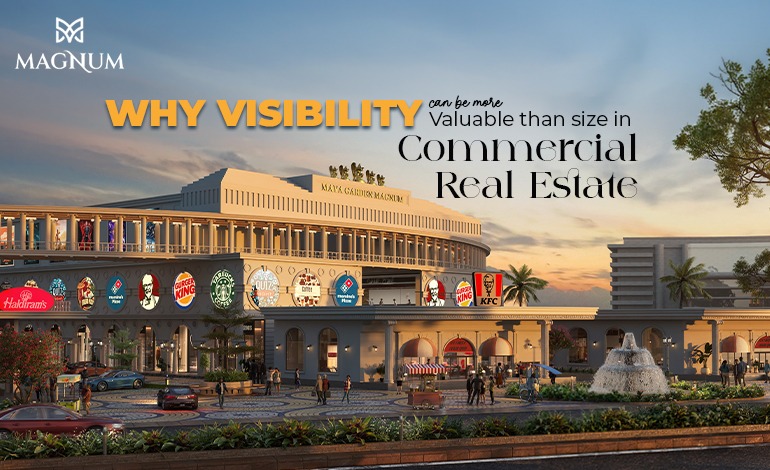
Maya Garden Magnum is an example of how strategic positioning and prominent frontage can shape a high-street retail destination. Strategically located on the Rajpura-Ambala National Highway, the project spans approximately 8 acres and features an expansive 550-foot frontage, creating a strong road presence for businesses operating within the development.
Designed around a distinctive Neo-Classical architectural theme, Magnum combines retail with dining, entertainment, and hospitality. Its planned mix includes premium retail showrooms, fine dining, food courts, microbreweries, multiplex theatres, gaming zones, and luxury hotels.
The development also features The Celestial Ring, a unique skywalk designed to connect different areas of the commercial destination. Ample parking, EV charging stations, power backup, 24×7 gated CCTV security, and seamless connectivity further contribute to its overall functionality.
Its positioning amid residential and industrial hubs adds another dimension to the development. For businesses, the combination of highway visibility, substantial frontage, accessibility, and a diverse commercial mix demonstrates why location can sometimes matter more than simply having additional floor area.
Maya Garden Trillium: Turning Location Into a Retail Experience
Maya Garden Trillium offers another example of visibility-led high-street development. Located on the Patiala-Sangrur National Highway, the project is spread across approximately 5 acres and features 400 feet of frontage with a pro-retail layout designed around accessibility and visibility.
Its Canadian-inspired architectural theme gives the development a distinct identity. The commercial mix includes retail showrooms, drive-thrus, cafés, microbreweries, a food court, gaming zones, and a premium luxury hotel.
For brands, this combination creates multiple opportunities to attract and engage customers. A prominent location provides visibility, while a diverse commercial environment can encourage visitors to spend more time within the destination.
For investors researching commercial shop investment in Punjab, Magnum and Trillium demonstrate an important principle: the commercial potential of a property cannot be judged by area alone. Frontage, highway connectivity, surrounding catchment, accessibility, and the mix of businesses can all be important considerations.
Connectivity Can Add to Commercial Property Potential
Visibility and connectivity often work together. A property that can be easily seen but is difficult to reach may not provide the same advantages as one that combines visibility with convenient access.
Major roads and highways can connect commercial developments with wider catchment areas. Properties positioned along important corridors can potentially attract customers from neighbouring cities and towns in addition to the immediate local population.
The highway-oriented locations of Maya Garden Magnum and Maya Garden Trillium demonstrate this relationship. Magnum’s position on the Rajpura-Ambala National Highway and Trillium’s location on the Patiala-Sangrur National Highway provide exposure to important regional movement corridors.
Parking is another practical consideration. A highly visible property with inadequate parking or difficult entry and exit can create friction for customers. Good commercial planning therefore needs to consider the complete customer journey, from seeing the property to reaching and entering it.
Visibility vs. Size: What Should Investors Consider?
Choosing between a larger property and a more visible one is not always a simple either-or decision. The right choice depends on the intended use, target customers, location, and business model.
Before buying commercial property in Punjab, investors can consider:
- How visible is the property from the main road?
- Is the frontage suitable for branding and signage?
- What type of footfall does the location receive?
- How easy is it to enter and exit?
- Is sufficient parking available?
- What businesses operate nearby?
- What residential or commercial developments are planned around it?
- How well is the property connected to major roads?
- What is the current and potential tenant demand?
- What approvals, title, and RERA details should be verified?
These questions provide a more complete picture than simply comparing carpet area or total built-up area.
Industrial Real Estate Requires a Different Definition of Visibility
Visibility has a different meaning when discussing industrial property. An industrial plot does not necessarily need high pedestrian footfall or prominent retail frontage.
For an industrial park near Chandigarh, accessibility for commercial vehicles, highway connectivity, plot configuration, infrastructure, and proximity to markets may be considerably more important.
The same principle applies to an industrial park in Punjab or a heavy industrial plot. Here, visibility can mean logistical accessibility and connectivity rather than storefront exposure.
This distinction matters because different commercial property formats have different requirements. A retail business may prioritise customer visibility, while an industrial operator may prioritise transportation infrastructure and access to major routes.
Can Visibility Influence Rental Potential?
Location is an important consideration when assessing the potential rental performance of commercial real estate. Businesses generally look for spaces that can help them reach their target customers efficiently, although rental outcomes ultimately depend on market conditions, property specifications, and tenant demand.
A prominent commercial location may appeal to businesses seeking customer exposure, particularly in sectors such as retail, food and beverage, beauty, healthcare, and services. Therefore, investors researching rental income from commercial property in Punjab should consider visibility and tenant suitability alongside the property’s purchase price.
Rental potential should not be evaluated on visibility alone. Lease terms, maintenance costs, vacancy periods, local competition, and the overall health of the market are equally relevant.
The Changing Commercial Real Estate Landscape in Punjab
Punjab’s commercial property landscape includes a wide range of formats, from high-street retail and organised shopping destinations to industrial parks and highway-oriented developments.
As cities expand and connectivity improves, commercial activity can increasingly extend beyond traditional city centres. Locations around Chandigarh, Mohali, Zirakpur, Rajpura, Patiala, and other growing corridors are becoming part of a broader commercial network.
For buyers and investors, this creates more choices. At the same time, it makes careful location analysis increasingly important. A property should be evaluated not only for what surrounds it today, but also for how the wider micro-market may evolve.
The developments of Maya Garden Group, including Maya Garden Magnum and Maya Garden Trillium, illustrate how high-street commercial developments can combine distinctive architecture, prominent frontage, connectivity, and diverse business formats to create destination-oriented spaces.
What Makes a Commercial Property Worth Considering?
The strongest commercial opportunities are rarely defined by one feature alone. A property may have excellent visibility but limited accessibility, while another may offer substantial space but weak customer movement.
A third may have a smaller footprint but benefit from a strategic location and a strong surrounding ecosystem. This is why commercial real estate should be assessed as a combination of factors rather than through square footage alone.
For businesses, visibility can improve discoverability. For investors, location can influence tenant demand. For customers, accessibility can determine convenience. When these elements come together, a commercial property can become more than just a physical space.
Final Thoughts
In commercial real estate, size is easy to measure, but visibility can be what makes that space commercially relevant. A well-positioned property can put a business closer to customers, strengthen brand exposure, and become part of an active commercial ecosystem.
Whether you are exploring commercial shop investment in Punjab, a high-street retail opportunity, an industrial plot, or another form of commercial property, look beyond the number of square feet. Consider road presence, frontage, footfall, accessibility, connectivity, surrounding development, and the long-term purpose of the property.
Ultimately, the question is not simply, “How much space am I getting?” It is also, “How effectively can this space connect with the market?”