
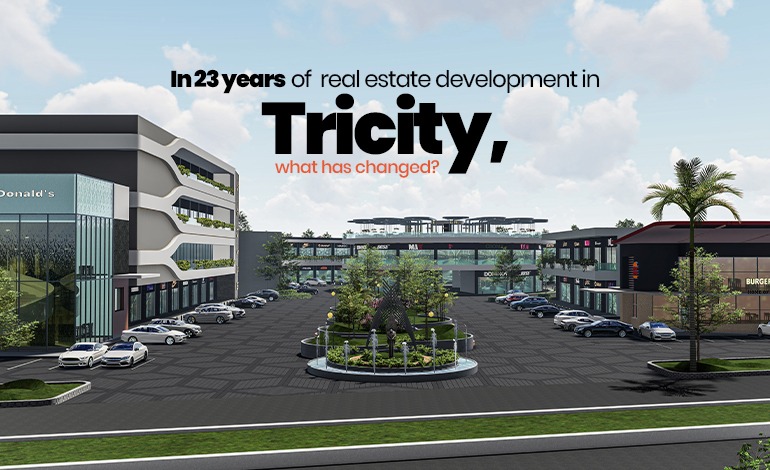
There is a version of the Chandigarh-Mohali property market story that gets told through price charts and project launches. It is accurate, but it misses something. The real story of how this market developed over the last 23 years is about what kept happening even when nobody was paying attention — the infrastructure decisions made years before their effect was felt, the regulatory overhaul that separated serious developers from opportunistic ones, and the slow accumulation of credibility that made Tricity one of the most trusted real estate markets in North India today.
Understanding that story matters because the best decisions in any property market are made by people who know how it got to where it is, not just where it is. And right now, Tricity is in a moment where knowing the context changes what you see when you look at the opportunities in front of you.
When Mohali Was Still a Bet
In 2002, buying property in Mohali required a specific kind of conviction. Chandigarh’s fixed development boundaries and controlled planning framework meant that the city could not grow outward to absorb rising demand. Mohali — formally SAS Nagar — was the natural overflow, with planned sectors and available land. But infrastructure was still catching up. Schools, hospitals, and daily conveniences were sparse in most sectors. The case for buying here rested entirely on what the area would look like in a decade, not what it looked like on the day you visited.
The buyers who came in during this period were patient by necessity. They were government employees, retired military personnel, and private sector professionals who had done their research and were willing to wait. The developers operating in Mohali at this time were building modest projects — plotted developments, low-rise residential floors, and early apartment complexes. Satish Jindal Group, through what would become Maya Garden Group, was among those laying early foundations in the Tricity region during these years. What separated the developers who succeeded from those who didn’t was the size of their projects. It was whether they had the experience and discipline to actually finish what they started. That distinction would become far more visible — and far more consequential — in the cycle that followed.
The Boom That Revealed Everything
Between 2008 and 2014, two announcements changed the trajectory of the Tricity market. The Infosys campus in Mohali validated the city as a serious IT destination. The expansion and internationalization of Chandigarh Airport made the entire region accessible in a new way. Residential prices in sectors 66 through 82 experienced a sharp upward movement. Demand came from IT professionals, buyers relocating from the Delhi NCR area, and investors who had been watching the market from the sidelines and finally felt the moment had arrived.
New developers entered the market in volume. The problem was that a rising market can make almost anyone look competent for a while. Projects were announced with timelines that lacked real engineering support. Booking amounts were collected on the strength of well-designed brochures. And then delivery dates started slipping — by months at first, then by years. Families who had planned to move into their homes by 2012 were still in dispute with developers in 2016. The boom produced some of the best early returns the Tricity market has ever generated. It also produced some of its worst experiences for buyers who chose the wrong developer.
Along NH-22 through Zirakpur, a quieter development was underway. Commercial activity along this highway corridor was building steadily. The daily vehicle counts on this national highway — connecting Chandigarh to Shimla and drawing significant transit traffic — were establishing the structural footfall case that would make commercial property in Zirakpur a compelling investment category in the decade ahead. The opportunity was visible to anyone who looked carefully. Most people were watching the residential boom and not looking at the highway.
The Regulation That Changed Everything
RERA arrived in Punjab in 2017, and its effect on the Tricity real estate market was more significant than most buyers initially realized. Mandatory project registration, escrow accounts for collected funds, enforceable possession timelines, and formal buyer grievance mechanisms not only protected buyers from future problems but also ensured transparency and accountability. They restructured the competitive landscape entirely.
Developers with a genuine history of on-time delivery found that their track record had become their most valuable asset — more valuable, in many cases, than their location advantage or their pricing. The buyers who had been burned in the previous cycle came back to the market, but they came back differently. They were asking questions that hadn’t occurred to them before. How many projects has this developer completed? Are there real families living in those homes? Did possession happen when they said it would? Maya Garden Group, with its established presence across the Tricity region and its portfolio of completed projects, was among the developers that benefited from this shift in buyer behavior. Nineteen delivered projects and more than 10,000 families as residents is not a marketing line — it is the kind of verifiable track record that the post-RERA market began specifically rewarding.
Tricity’s identity was also maturing independently during this period. Mohali was no longer simply Chandigarh’s growth corridor. It had its own commercial districts, its own IT campuses, and its own established residential character. Zirakpur, positioned at the junction of highways connecting Chandigarh to Patiala, Ambala, and the broader Delhi NCR corridor, was developing its own distinct real estate market — commercial and residential — with fundamentals that stood on their own rather than depending on Chandigarh’s proximity.
What the Pandemic Unlocked
When COVID-19 arrived in 2020, the conventional expectation was that property markets would contract. In Tricity, something more complicated happened. Remote work changed what people actually wanted from their homes — larger floor plans, dedicated workspaces, outdoor areas within gated communities, and cities where quality of life didn’t require a metro budget. Tricity offered all of this. Buyers who had been looking at Delhi NCR and finding it too expensive, too congested, and too far from the quality of life they wanted began arriving in the Chandigarh-Mohali market with a level of seriousness and purchasing power that hadn’t been seen before.
NRI property investment in the Chandigarh and Mohali region reached levels not seen in prior cycles. The combination of RERA compliance, established developer track records, airport proximity, and favorable exchange rates made Tricity a credible destination for NRI buyers who had historically been cautious about committing to Indian real estate. RERA-approved residential projects — gated societies with 2BHK and 3BHK configurations, proper amenities, and transparent possession timelines — absorbed the majority of this demand. Projects like Maya Garden Magnesia in Zirakpur, positioned with direct access to highway connectivity and proximity to Chandigarh International Airport, were representative of what this phase of the market looked like when it was done correctly.
On the commercial side, highway real estate proved its resilience through the pandemic in a way that city-center retail did not. A mixed-use commercial project on NH-22 in Zirakpur — combining retail shops, food court space, SOHO units, office floors, and serviced apartments — draws its footfall from structural traffic volume on a national highway. That traffic did not disappear during the pandemic the way mall footfall did, and it returned faster when restrictions lifted. Investors who understood this distinction moved toward highway commercial real estate in Zirakpur, and those who got into well-structured, RERA-approved projects from credible developers have seen that reasoning validated.
Industrial real estate in Punjab began receiving serious attention during this same period. Manufacturing operations under pressure in land-constrained metro regions began evaluating relocation to Punjab’s highway corridors — where freehold industrial land was available, highway connectivity had improved significantly, and PPCB-approved plots gave operators the regulatory clarity they needed to plan long-term. Maya Garden Industrial Park emerged from this context, bringing organized industrial development with planned infrastructure and PPCB approval to a market that had historically been served only by fragmented, unorganized industrial land transactions.
Where the Market Is Now — and Where the Opportunities Are
The Tricity property market in 2025 is more diverse, more regulated, and more credible than at any point in its history. The residential market has been segmented clearly between mature neighborhoods, where you are buying certainty, and emerging corridors, where you are buying potential. Commercial real estate spans organized highway projects in Zirakpur, Rajpura, and the Patiala-Sangrur belt. Industrial real estate is developing into a genuine investment category. Understanding which of these fits your situation requires being honest about what you are actually trying to achieve.
For residential buyers, Zirakpur’s appeal in 2025 is straightforward. Highway connectivity in every direction, proximity to Chandigarh International Airport, affordable flats relative to Chandigarh city pricing, and a rapidly improving amenity base. Ready-to-move flats and RERA-approved gated societies in Zirakpur are what end-users with defined timelines are prioritizing. In Mohali, the established sectors from 66 to 82 offer a mature, proven neighborhood. The emerging sectors from 85 to 115 offer better entry pricing for investors who can hold a longer position as infrastructure continues to develop.
For commercial property investors, the highway corridors represent the most differentiated opportunity in Tricity right now. Commercial property on NH-22 in Zirakpur — particularly in mixed-use projects that combine retail, food court space, office floors, and serviced apartments — captures structural highway footfall that does not depend on discretionary consumer behavior. Maya Garden Magnesia on the Zirakpur highway is the group’s answer to this demand. On the Rajpura-Ambala highway, Maya Garden Magnum brings the same mixed-use commercial format to a corridor that is still in its growth phase — with entry pricing that reflects earlier development and upside that reflects where this corridor is heading over the next five to seven years. On the Patiala-Sangrur highway, Maya Garden Trillium addresses a market predominantly driven by the region’s service and manufacturing economy — consistent, utilitarian demand that organized high street retail has not yet fully met.
For industrial buyers, Maya Garden Industrial Park represents something the Punjab market has needed for a long time: organized industrial development with PPCB approval, freehold tenure, planned internal infrastructure, and highway positioning. Industrial investment in this region is a ten-year story. Entry pricing today reflects a market that has not yet caught up to its own demand-side fundamentals. Buyers who understand that timeline and are comfortable with it will find this category compelling.
Conclusion
Twenty-three years is a long time to be building in one market. Maya Garden Group has spent those years delivering residential communities, commercial developments, and now industrial real estate across the Chandigarh-Mohali region. The Satish Jindal Group’s real estate arm has 19 completed projects, over 1,500 acres developed, and more than 10,000 families as permanent residents of its communities. Those numbers are not projections. They have a track record that exists on the ground, in projects that are occupied and operating, built by a team that has been in this specific market through every phase it has gone through.
The market has changed enormously since 2002. What buyers want has changed, what regulations require has changed, and what ‘quality’ means has changed. What hasn’t changed is the basic logic of how good property investment works: find the right location, choose a developer whose previous work you can actually visit and verify, and give the investment the time it needs to do what it is supposed to do. That was true in 2002. It is still true today.