
You have been on the road for an hour. You are hungry, the kids are restless, and your phone is on 10%. You won’t take a detour into the city to find a mall. You are going to stop at the first clean, visible, well-built place right on the highway, and you are going to spend money there. That moment, that simple, unplanned decision, is exactly why highway commercial projects are becoming one of the most discussed opportunities in Indian real estate today.
For decades, the focus was on city centres. The busier the street, the better the shop. But something has shifted. As India’s highway network has expanded dramatically, the roads connecting our cities have stopped being just roads. They have become economic corridors, and the commercial projects sitting along them are quietly turning into some of the most valuable real estate in the country.
This is not a coincidence. It is location logic. Highway commercial projects are no longer just petrol pumps and dhabas. They are experience-driven, mixed-use destinations that combine retail, dining, offices, and hospitality under one roof right where the traffic already is. This blog breaks down why that is happening, who is benefiting from it, and what a project like Maya Garden on NH-22 in Zirakpur tells us about where this trend is heading.
Location Is Everything, and Highway Projects Know It
In commercial real estate, location is not just one of the factors; it is usually the deciding one. A beautifully designed project with great amenities but poor placement will always struggle. And a well-placed project on a busy highway will always have something that money cannot easily buy: natural visibility and daily traffic.
Highway commercial projects are built right where the action already is. Instead of waiting for customers to find them, they position themselves directly in the path of people who are already moving. Commuters, business travelers, families on road trips, delivery drivers, tourists heading to hill stations, all of these people pass through the same corridor every single day. A highway-facing project does not need to announce itself. The road does that for free.
The Billboard Effect: Free Visibility, Every Single Day
Imagine a shop tucked inside a busy city lane. To get customers, the owner has to spend on pamphlets, social media ads, hoardings, and word of mouth. Even then, many people will simply never know it exists. Now imagine a shop sitting right on a highway with a large, clear frontage facing thousands of vehicles every day. Drivers see it on Monday. They see it again on Wednesday. By Friday, they remember it. That repeated, automatic visibility is what is called the billboard effect, and it is one of the biggest silent advantages of highway commercial real estate.
A highway-facing project with wide road frontage works like a permanent, round-the-clock advertisement for every business inside it. Brands get seen consistently by a large, rotating audience without spending a single rupee extra on awareness. Over time, this builds recognition, trust, and the kind of familiarity that drives people to actually stop and walk in.
For any retail or service brand, this is not a small thing. Visibility is the foundation of customer acquisition. Properties hidden inside dense city grids have to fight hard and spend heavily to overcome the disadvantage of not being seen. Highway-facing projects start with that advantage already built in.
Why People Stop at Highway Projects (And Keep Coming Back)
People today are not just looking to buy something. They want the experience around it, the ease, the comfort, the convenience of having everything in one place. Highway commercial projects that understand this are building more than just shops. They are creating destinations.
Think about what a well-designed highway commercial project actually offers:
- Landscaped open areas where families can sit and relax
- Food courts with multiple dining options under one roof
- Entertainment zones for kids and adults
- Premium retail outlets alongside everyday stores
- Ample, easy parking, no circling for 20 minutes like in a city
When you put all of this together, a quick stop for food or fuel turns into a longer visit. And longer visits mean more time spent, more money spent, and a real reason to come back. This directly benefits every business inside the project.
People today want what it feels like, not just what they buy. The experience of stopping at a clean, well-designed highway destination versus pulling over at a random roadside stall is a different thing entirely. Projects that get this right build genuine customer loyalty, stronger sales, and a reputation that spreads on its own. As retail keeps evolving, the developments that blend accessibility, convenience, and experience together are setting the standard for what commercial real estate looks like going forward.
India’s Highway Network Is Growing Fast
The growth of highway commercial real estate in India is directly connected to the growth of the highway network itself. And that growth, by any measure, has been significant. According to the Ministry of Road Transport and Highways, India’s National Highway network has expanded from 91,287 km in 2014 to 1,46,572 km, a growth of more than 60%. The length of operational access-controlled expressways has jumped from just 93 km to 3,052 km in the same period.
Four-lane and above highways have increased by 2.6 times, which means more land along these corridors is now accessible, more communities are forming around them, and more commercial activity is following naturally.
The government’s forward targets make this trend even clearer:
- Operationalizing 18,000 km of access-controlled highways and expressways by 2028-29
- Awarding 26,000 km of new highway projects by 2032-33
- Continued focus on ring roads, bypasses, port connectivity, and industrial corridor linkages
What this means practically: as highways expand and improve, the land and commercial space along these corridors becomes more valuable, more visible, and more connected to larger economic activity. Highway commercial real estate is not growing in isolation; it is growing because India’s infrastructure backbone is growing around it. And when infrastructure grows, business and investment follow.
Why Investors Are Paying Attention to Highway Commercial Assets
Highway commercial projects have become a serious consideration for local buyers, NRIs, and business owners alike, and the reasons are grounded in straightforward fundamentals rather than speculation.
Consistent Demand from Retailers Retail brands are always looking for locations with high visibility and easy customer access. Highway-facing commercial projects naturally provide both. Established brands often prefer these locations because the exposure is built into the address no extra work required to be seen.
Premium Rental Income When a property sits on a prime highway corridor, businesses are often willing to pay stronger rents. The highway location gives them a strategic advantage in visibility, parking, and customer access that a city lane simply cannot match. That premium is reflected in what they are willing to pay each month.
Long-Term Value Appreciation As infrastructure improves and populations grow along highway corridors, commercial real estate in these areas tends to rise in value over time. This appreciation is typically gradual and steady, which suits investors with a medium-to-long-term outlook, whether they are based locally or overseas.
Lower Vacancy Risk Highway locations that attract consistent traffic and a healthy mix of businesses tend to have stronger occupancy. When footfall is naturally built into the location, businesses have a better foundation to survive and grow, and that stability benefits property owners too.
Here is how highway commercial assets compare with typical city commercial properties:
| Factor | City Commercial Property | Highway Commercial Project |
| Visibility | Limited, needs marketing spend | Natural, road-facing exposure daily |
| Customer base | Mostly local neighborhood | Locals + commuters + travelers |
| Footfall pattern | Peaks on weekends | Steady across all 7 days |
| Rental demand | Depends on the locality density | Driven by highway traffic volume |
| Long-term value | Tied to local development pace | Tied to infrastructure corridor growth |
| Vacancy risk | Higher in saturated city markets | Lower with consistent passing traffic |
| Suitable for | Local buyer, small investor | Local buyer, NRI, business owner |
For investors looking at both income today and capital growth over time, highway commercial real estate presents a combination that is difficult to replicate in most other asset categories.
Strategic Location Creates a Real Competitive Edge
In commercial real estate, the phrase “location advantage” is often used. On highways, it is not just a phrase; it is the actual business model. Highway commercial projects are placed along transportation routes that connect cities, residential areas, industrial zones, and newer growth centers. Because the road traffic is already there, businesses inside these projects can draw customers from multiple directions without depending on a single neighbourhood or catchment area.
Most well-positioned highway commercial projects are located near:
- Major city entry and exit points
- Fast-growing residential communities
- Industrial or manufacturing zones
- Educational institutions, such as schools, colleges, and universities
- Tourist destinations and hospitality clusters
- Key transportation junctions and transit hubs
This placement means the customer mix is naturally diverse, including daily commuters, working professionals, students, families, business travelers, and tourists. Retailers do not need to depend on one customer type or one season. Footfall tends to stay consistent across the week and the year. For a business owner, this means you are not betting on one neighbourhood doing well. For an NRI investor sitting abroad, it means your asset is not dependent on the fortunes of one small locality; it is connected to a highway corridor that serves an entire region.
Why Mixed-Use Projects Work Better on Highways
Commercial development has moved well beyond just retail. The projects that perform best today combine retail with dining, hospitality, entertainment, office space, and service businesses all in one destination. This is what is called a mixed-use commercial ecosystem. On a highway, this approach gets amplified. When a project is easy to reach from multiple cities and regions, it can attract a wider audience than a standalone mall or a single-use commercial building ever could.
Here is a simple example of how the ecosystem effect works in real life:
A family stops at a highway commercial project for lunch. While the food is being prepared, the kids go to the play zone. The mother picks up groceries from the hypermarket. The father gets a quick haircut. On the way out, they stop at the pharmacy. One stop, five different businesses just made a sale. That cross-shopping effect is the engine of a mixed-use project. And on a highway, where people are already stopping for a break, it works even more naturally than in a city location.
The measurable outcomes of this model:
- Longer visitor stay durations. People spend more time when there is more to do
- More cross-shopping between businesses. One visit benefits multiple tenants
- Higher average spending per visit, Longer stays almost always mean more spending
- Stronger overall occupancy. A lively project attracts and retains more tenants
As consumer preferences keep shifting toward convenience-led and experience-focused destinations, this integrated model is becoming a defining feature of successful highway commercial projects and a key reason why they consistently outperform single-use developments.
Maya Garden: A Real-World Example of This Model
It is one thing to explain highway commercial real estate in theory. It is more useful to look at a real project that reflects these principles on the ground. In the Tricity region covering Chandigarh, Mohali, Panchkula, and Zirakpur, Maya Garden is one of the clearest examples of this model in practice. Developed by Barnala Builders, Maya Garden is not a single building. It is a collection of residential and commercial phases spread across Zirakpur along the Chandigarh-Ambala Highway (NH-22). Over the past decade, these projects have helped shape the character of the area, and the established community that has grown around them is a significant part of what makes the commercial side of the project viable.
Maya Garden City (Nagla / Ambala Highway)
This is one of the largest residential townships in the Zirakpur belt.
- Spread over approximately 23 to 42 acres, with dozens of towers (around 8 floors each) and over 1,500 units
- Offers a wide range of flat sizes from compact 1BHK and 2BHK units all the way up to large 5BHK and 6BHK penthouses
- Located on the 200-foot wide Airport Ring Road bypass, directly opposite the Zirakpur KFC and McDonald’s zone
- Provides residents with direct, quick access to Chandigarh, Mohali, and the Chandigarh International Airport
A township with over 1,500 families living in it creates a ready, everyday customer base for any commercial development nearby. This is existing, real demand, not projected numbers on a sales brochure.
Maya Garden Phase 1, 2, and 3 (VIP Road and Gazipur)
The earlier phases of Maya Garden built the brand’s reputation in the region before the larger township came up.
- Phase 3 (Bishanpura/Gazipur): A RERA-approved, ready-to-move gated society with around 12 towers, focused on 3BHK layouts. Popular among mid-segment families for its good connectivity to public transport and local markets
- VIP Road Phases: Located in the active VIP Road corridor, known for high daily footfall and strong access to everyday essentials, schools, hospitals, and grocery stores
These phases matter for any investor because the communities living there are established. The shops, pharmacies, and service businesses around these gates already have a functioning, daily customer base. This is not a new project waiting for residents to arrive; the residents are already there, and they have been for years.
Maya Garden Magnesia (Highway-Facing Commercial Project)
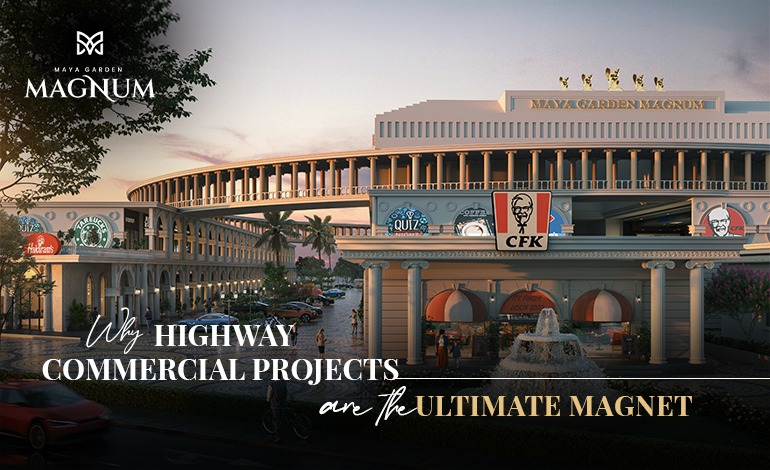
Magnesia is the commercial flagship of the Maya Garden ecosystem, positioned directly on the Chandigarh-Ambala Highway.
- A 3-side open corner plot visible from multiple road directions, not tucked away in a lane
- Brings together retail units, office spaces, a hypermarket, food courts, and serviced apartments in a single destination
- Positioned on a corridor that connects Chandigarh, Delhi, and Himachal Pradesh, meaning traffic comes from multiple major destinations, not just one city
For a local buyer or business owner: Magnesia offers a visible, accessible commercial address on a highway that thousands of vehicles travel daily. Whether you want to run a business yourself or lease the unit to a brand, the footfall foundation is already there.
For an NRI investor: The project sits on an infrastructure corridor that connects some of North India’s busiest cities and is backed by an established residential community next door. The asset is not dependent on one small locality it is tied to a regional highway that continues to grow in importance.
For a business owner: Magnesia is designed as a mixed-use destination, meaning your business benefits from the cross-shopping effect. A customer who comes in for the hypermarket may also visit your store. A family stopping for food may also browse your retail outlet. The ecosystem works in your favour.
What gives Magnesia a practical, ground-level advantage is simple: it does not have to build its audience from scratch. The highway traffic is already there. The residential community next door is already there. The corridor connects major cities that are not going anywhere. The foundation is real, not a future promise.
FAQ
Q: What exactly is a highway commercial project?
A highway commercial project is a business and retail complex built along a busy national highway. It typically includes shops, food outlets, offices, and sometimes hotels or serviced apartments. Unlike a city mall that relies on people planning a visit, a highway project captures customers who are already traveling on the road, making footfall natural and consistent across the entire week.
Q: What is the billboard effect in highway commercial real estate?
The billboard effect refers to the free, automatic visibility that highway-facing properties get simply because of their location. A shop or project with large road frontage is seen by thousands of passing vehicles every day. Over time, this repeated visibility builds brand recognition and customer recall without any extra advertising spend, giving businesses inside these projects a built-in marketing advantage.
Q: Why do highway commercial projects attract more consistent footfall than city malls?
City malls depend on planned visits, usually concentrated on weekends. Highway commercial projects draw from multiple customer types simultaneously: daily commuters, long-distance travelers, residents, logistics workers, and tourists. This diversity keeps footfall more stable throughout the week and across seasons, rather than spiking only on certain days.
Q: Does the growth of online shopping affect highway commercial real estate? Online shopping does not replace the kind of services highway projects offer. You cannot eat a meal, refuel a vehicle, service a car, or rest at a hotel through an app. Highway commercial projects serve immediate physical needs, things people require at that specific moment on a journey. These businesses occupy a category that e-commerce simply cannot enter.
Q: What types of businesses typically succeed in highway commercial projects? Businesses that serve immediate needs perform best in restaurants and food courts, pharmacies, fuel stations, auto services, ATMs, hypermarkets, hotels, and logistics offices. These are businesses that travelers and commuters need right now, on the road. Service businesses also do well because highway addresses offer wide visibility and easy parking access that city locations struggle to match.
Q: Is a highway commercial project a good option for an NRI investor?
Yes, for a specific reason. An NRI investor needs an asset that does not depend on one small neighbourhood staying active. A highway commercial property is tied to a corridor, a road that serves an entire region. As long as the highway stays active (and India’s highway network is actively expanding), the asset retains its relevance. When paired with an established residential community nearby, it adds another layer of stability.
Q: What is Maya Garden Magnesia, and where is it located?
Maya Garden Magnesia is a highway-facing mixed-use commercial project on the Chandigarh-Ambala Highway (NH-22) in Zirakpur, developed by Barnala Builders. It is a 3-sided open corner plot combining retail units, office spaces, a hypermarket, food courts, and serviced apartments designed to serve traffic moving between Chandigarh, Delhi, and Himachal Pradesh.
Q: Why does the established residential community around Maya Garden matter for investors?
A commercial project surrounded by occupied, established residential societies already has a built-in daily customer base. The families living in Maya Garden City and nearby phases represent real, everyday demand for retail, dining, and services. For any investor local, NRI, or business owner, this removes the biggest uncertainty of a new commercial project: whether customers will actually come. At Maya Garden, they already live next door.
Conclusion
India’s highway network is expanding at a pace that is reshaping how people move, where communities form, and where commercial activity follows. As national highways grow from simple transit routes into full economic corridors linking cities, industries, residential zones, and new growth centers, commercial real estate along these roads is becoming one of the more logical, grounded places to invest and operate a business. Highway commercial projects offer something genuinely difficult to replicate elsewhere: consistent, multi-directional footfall from a diverse customer base, built-in visibility that works like permanent advertising, and long-term value tied to infrastructure growth rather than any single neighbourhood’s fortunes.
For local buyers and business owners, it is about visibility, easy access, and a customer base that is not limited to one street or one colony. For NRI investors, it is about an asset connected to a regional corridor stable, growing, and not dependent on one small locality staying relevant. For consumers, it is simply about convenience, having what they need, exactly where they already are.
Maya Garden, with its large-scale residential communities and highway-facing commercial development along NH-22 in Zirakpur, reflects this model in a real, on-the-ground way. The combination of an established local population, a prime highway corridor, and a mixed-use design at Magnesia gives it a foundation that takes newer, isolated projects years to build if they manage to build it at all. As India’s highway infrastructure keeps expanding, well-positioned commercial destinations along these corridors are not simply following a trend. They are becoming a permanent part of how people shop, eat, work, and travel across the country. And projects that are already there, already established, already connected, already serving real communities are the ones best placed to grow with it.